Fixed price, time and materials or a dedicated team: which suits your project?
Three ways to pay for software, and how to pick: fixed price for a clear scope, time and materials while you learn, a dedicated team for a long roadmap.

Short answer: choose fixed price when the scope is clear and unlikely to change, time and materials when you expect to learn and change course as you build, and a dedicated team when you have a long roadmap and want people who stay with your product. Many good projects start with one model and move to another.
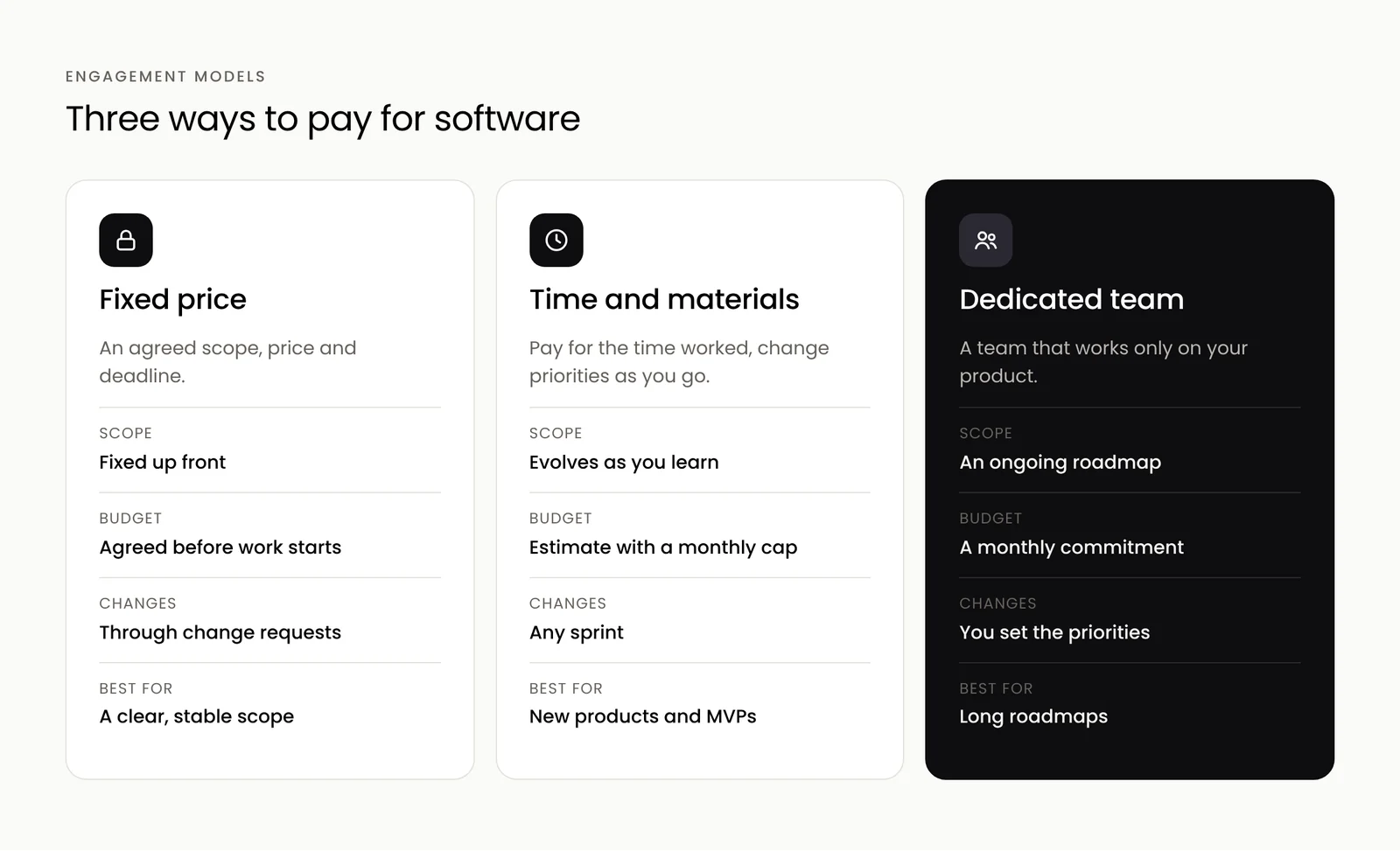
The three models in one line each
- Fixed price: an agreed scope, price and deadline. The development company carries the risk if the work takes longer.
- Time and materials: you pay for the time actually worked, usually against an estimate, and you can change priorities as you go.
- Dedicated team: a team works only on your product, month after month, and you decide what they work on next.
Fixed price: when the scope is clear
Fixed price works when you can describe what you want in detail before work starts: the screens, the user roles, the integrations and what "done" means for each feature.
What you get: budget certainty, a clear list of deliverables and a date.
What you give up: flexibility. Every change becomes a change request with its own price, and a careful vendor adds a buffer for risk, so you pay for uncertainty either way.
To make fixed price work:
- Write the requirements down and approve clickable designs before you sign. Our guide on collecting requirements shows how.
- Agree acceptance criteria for each feature, so nobody argues about "done".
- Tie payments to working software you can try, not to documents.
Time and materials: when you will learn as you build
New products rarely survive first contact with real users unchanged. If you are building an MVP, testing a market or expect feedback to reshape the roadmap, time and materials lets you change direction without renegotiating the contract.
What you get: flexibility, a faster start and no paying for buffers you do not need.
What you give up: a fixed number on day one. You manage that risk with a monthly cap, a prioritised backlog and a demo every one or two weeks, so you always see what the money bought.
Dedicated team: when software is your business
If your product is the business, a team that knows your users, your code and your domain gets faster every month. A dedicated team suits long roadmaps, continuous releases and products with many moving parts.
What you get: continuity, speed over time and full control of priorities.
What you give up: a monthly commitment, and you (or your product owner) need to keep the team pointed at the right problems. For short, well-defined projects it is usually the wrong model. We explain more in when to go for a resource allocation model.
A common path: fixed first, then flexible
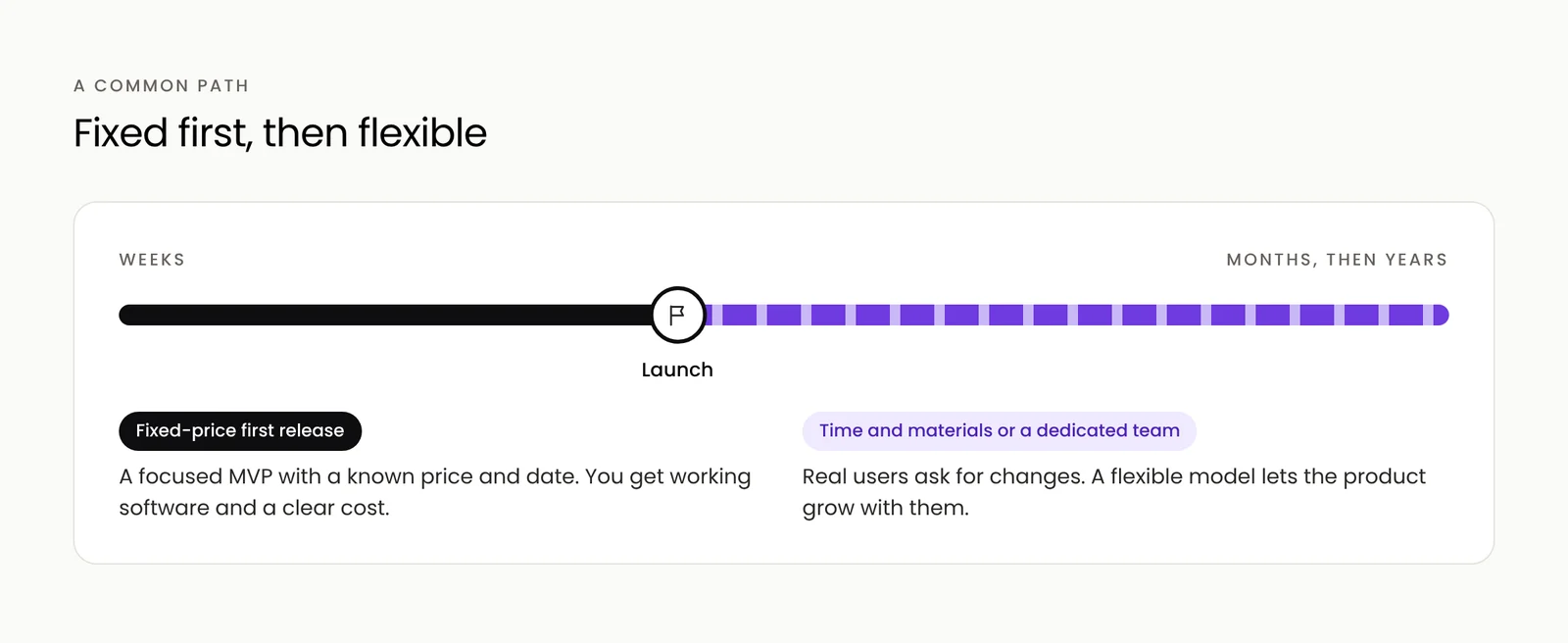
Many of our clients start with a fixed-price first release, a clear MVP with a known price and date, then move to time and materials or a dedicated team once real users start asking for changes. The fixed phase gives you a working product and a predictable cost. The flexible phase lets the product grow with its users. Our post on project-based development covers the first half of that journey.
How AI-native development changes the maths
With AI-native development, prototypes and first versions take days or weeks rather than months. That makes a short fixed-price discovery or MVP phase lower risk for both sides, and lets a smaller dedicated team cover more ground later. It does not remove the need for clear decisions: the faster the build, the more your speed of answering questions matters.
Questions to ask before you sign
- What exactly is in scope, and how are changes estimated and approved?
- How will we see progress: demos, test builds, a shared board?
- Who owns the code, the designs and the app store accounts, and from when?
- What happens after launch: warranty period, support hours and maintenance?
- Can we switch models later, and how much notice does either side need?
If you are weighing these options for a new product, tell us about it. We will suggest the model we would use and why.
Frequently asked questions
Is fixed price cheaper than time and materials?
Not necessarily. A fixed price includes a buffer for risk, so it can cost more if the scope stays lean. Time and materials can cost less for a focused scope, or more if the scope keeps growing. The real difference is who carries the risk of change.
Can we switch engagement models in the middle of a project?
Yes. Moving from a fixed-price first release to time and materials or a dedicated team is common. Agree in the contract how and when either side can switch.
Which model is best for an MVP?
Usually a short fixed-price discovery and MVP, or time and materials with a monthly cap if you expect to change direction quickly after early user feedback.


