Hiring a software development company in the UAE: what to check before you sign
Licences, contracts, VAT, data rules, Arabic and support hours: what to check before hiring a software development company in the UAE.

Short answer: check that the company is properly licensed, that the contract is clear on scope, ownership and governing law, that invoices show UAE VAT where it applies, that the team understands UAE data rules and Arabic, and that their support hours suit yours. A partner with teams in both the UAE and India can combine local presence with delivery capacity.
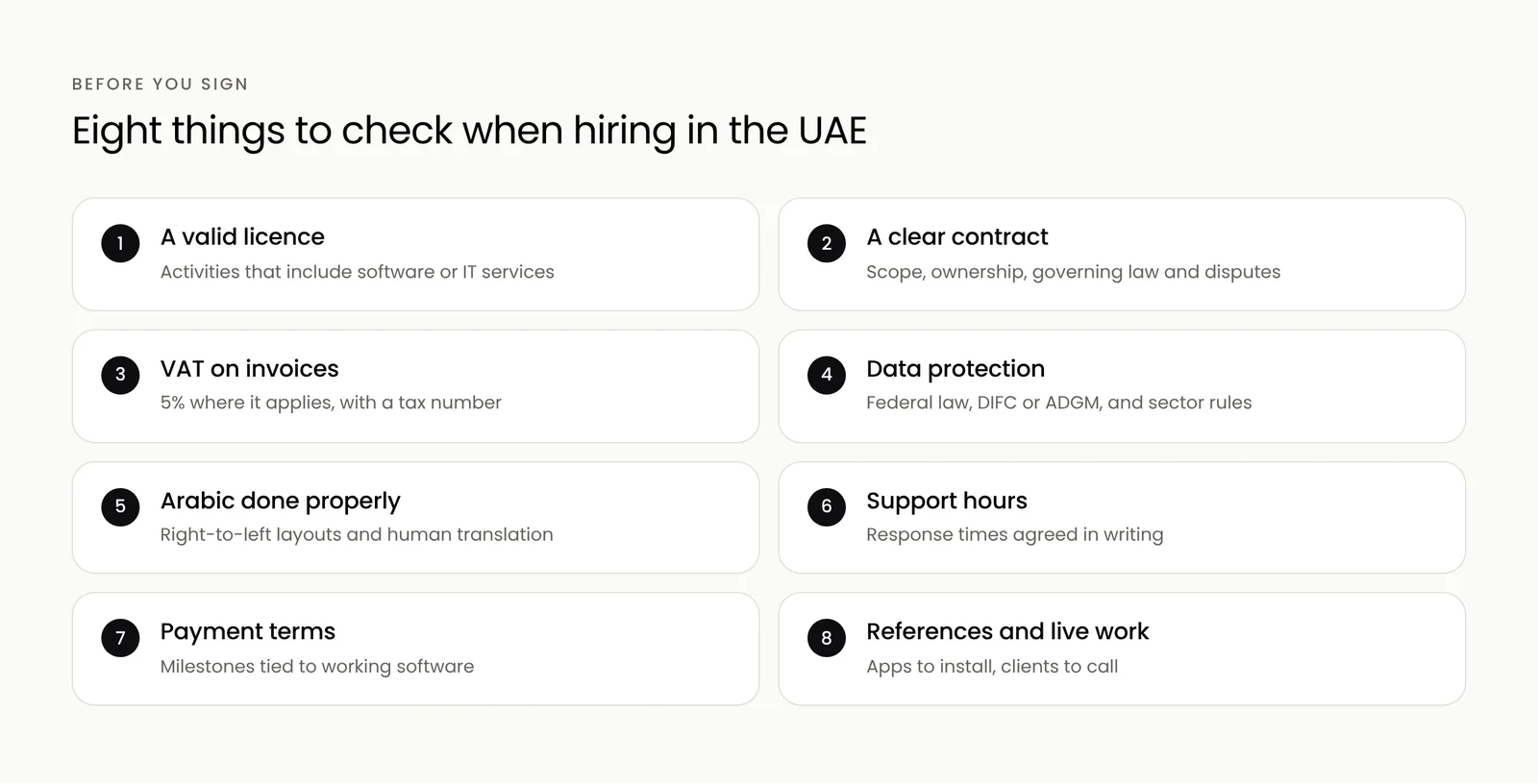
1. A valid licence
Ask for the company's trade licence and check that its activities include software development or IT services. Mainland and free-zone companies are licensed differently, which can affect who they can invoice and where they can work.
2. A clear contract
- Scope, milestones, acceptance criteria and how changes are priced.
- Ownership of code, designs and accounts passing to you on payment.
- Confidentiality and data protection.
- Governing law and disputes: UAE courts, the DIFC or ADGM courts, or arbitration. Agree this before you need it.
3. VAT on invoices
The standard VAT rate in the UAE is 5%. A VAT-registered supplier shows its tax registration number on invoices. Check how VAT applies to your contract, especially if the work is delivered from another country.
4. Data protection
The UAE's federal data protection law applies on the mainland, while the DIFC and ADGM free zones have their own data protection regimes, and sectors such as health have extra rules on where data can be stored. Your partner should know which apply to your app and design for them. We cover this in more detail in launching an app in the UAE.
5. Arabic done properly
If your users speak Arabic, ask to see apps the team has built with right-to-left layouts, Arabic typography and human translation, not just machine-translated strings.
6. Time zones and support
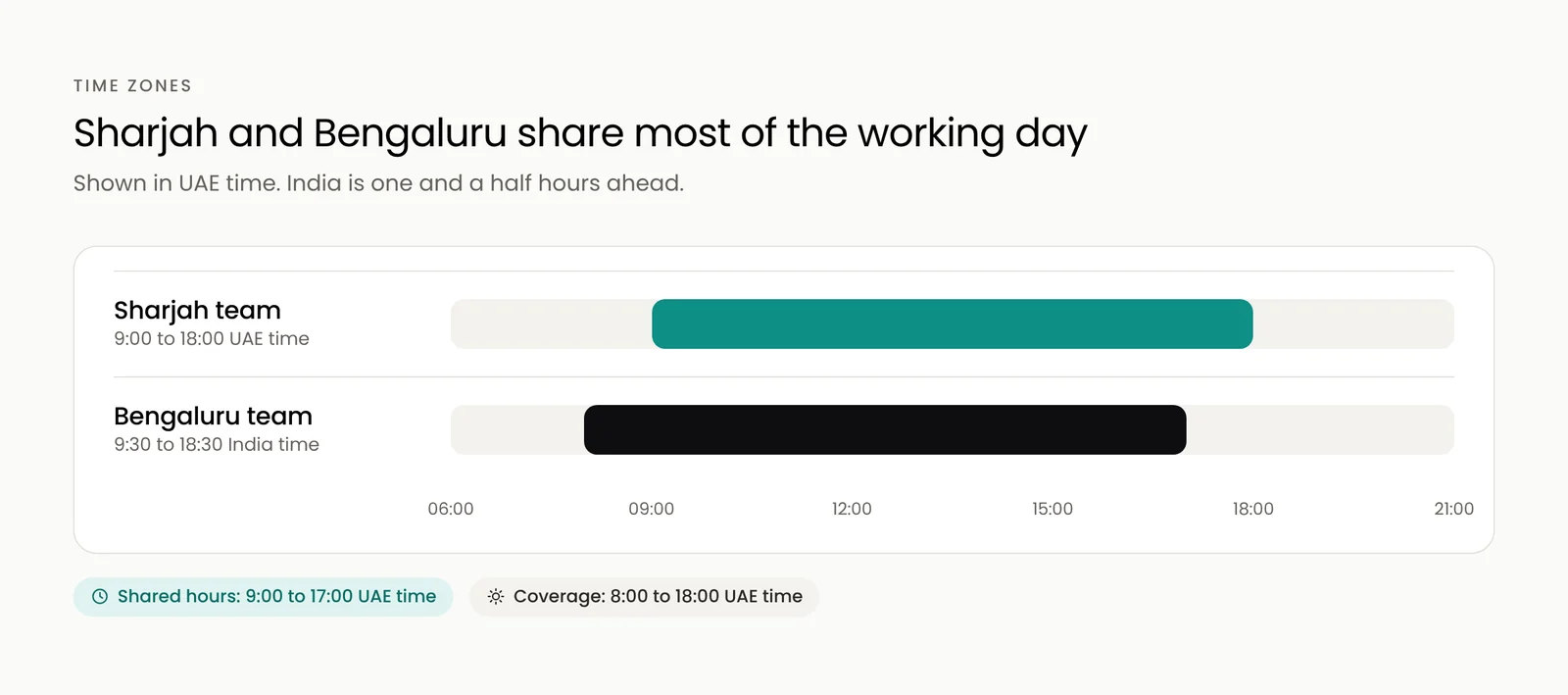
The UAE is one and a half hours behind India. A team split across Sharjah and Bengaluru shares most of the working day with UAE clients, with extra hours of coverage at either end. Agree support hours and response times in writing.
7. Payment terms
Milestone payments tied to working software you can try protect both sides. Be cautious with large upfront payments for work you cannot see.
8. References and live work
Ask for apps you can install and clients you can call, ideally in your sector and region.
Why a UAE and India team works
A UAE presence means workshops in person, local knowledge of payments, regulations and Arabic, and meetings in your working hours. A delivery team in India adds capacity and experience across many products. Humanoid Systems has offices in Sharjah and Bengaluru and builds web apps, mobile apps and platforms for clients in both countries.
Frequently asked questions
Do I need a UAE-licensed company to build my app?
Not necessarily, but a UAE-licensed partner makes contracts, VAT invoicing and in-person workshops simpler, and usually brings local knowledge of payments, regulations and Arabic.
Is VAT charged on software development in the UAE?
The standard UAE VAT rate is 5%, and VAT-registered suppliers charge it where it applies. How it applies to your contract depends on where the supplier and the work are, so confirm with your accountant.
What is the time difference between the UAE and India?
India is one and a half hours ahead of the UAE, so teams in both countries share most of the working day.


