Flutter vs React Native in 2026: which should a startup choose?
Both build iOS and Android apps from one codebase. How they differ, where each one wins, and what matters more than the framework.

Short answer: both are mature, proven ways to build iOS and Android apps from one codebase. Choose Flutter if you want a custom, branded interface that looks the same on every phone, with strong performance out of the box. Choose React Native if your team already works in React and TypeScript, or you want to share code and skills with a React web app. We plan our concepts in Flutter, for the reasons below.
How they work
Flutter apps are written in Dart. Flutter draws every pixel of the interface itself with its own rendering engine, so a button looks exactly the same on an iPhone and on a budget Android phone.
React Native apps are written in JavaScript or TypeScript with React. Your components become the platform's own native views, so the app picks up each platform's look by default. Its newer architecture, now the default, makes the bridge between JavaScript and native code faster and more direct.
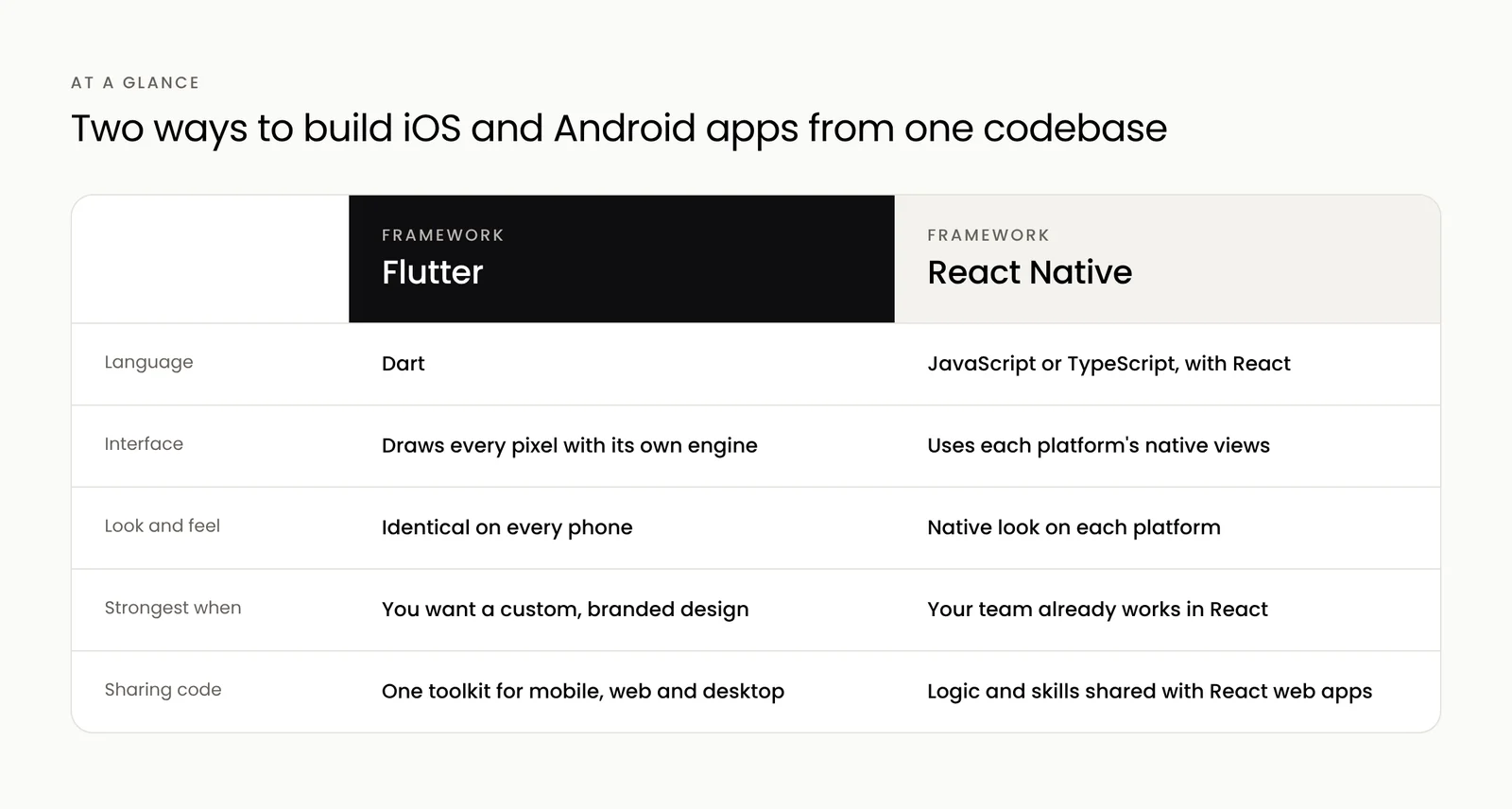
Where Flutter wins
- Custom design. When your brand has its own look, with custom components and motion, Flutter makes it consistent everywhere.
- Predictable performance. Because Flutter renders the interface itself, smooth scrolling and animation are easier to achieve across devices.
- One toolkit. Widgets, navigation, animation and testing come from one well-documented toolkit, which keeps projects consistent.
- Strong integrations. Official and community packages cover Firebase, maps, payments, camera and most of what an app needs.
Where React Native wins
- Your team knows React. If your web team writes React and TypeScript, they can contribute to the app quickly.
- Sharing with the web. Business logic, types and sometimes components can be shared with a React web app.
- Native look by default. Apps feel at home on each platform without extra work.
- Fast updates. For some changes, JavaScript updates can be shipped without a full app store release, within the stores' rules.
What matters more than the framework
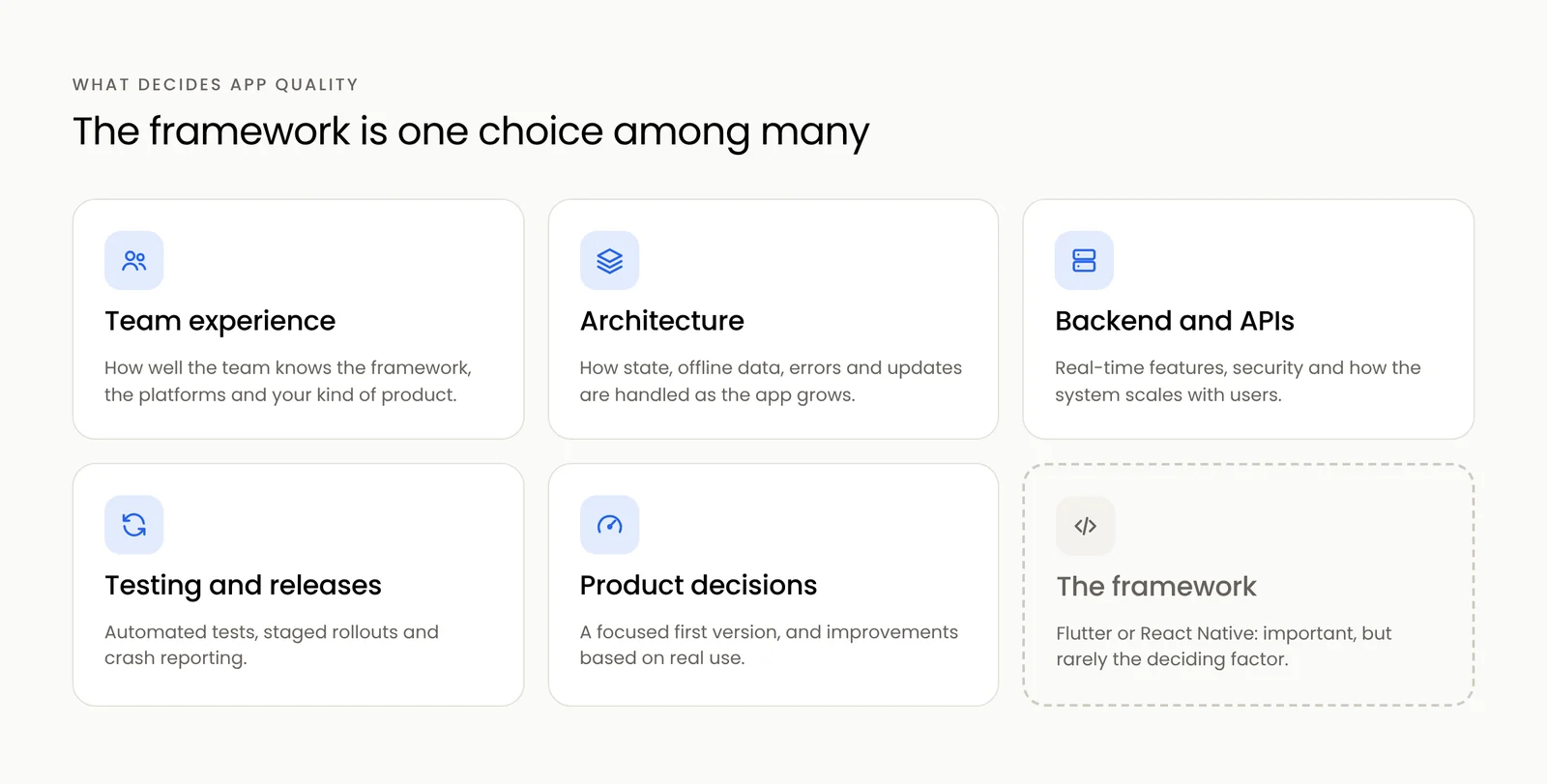
The framework is rarely what makes an app succeed or fail. These matter more:
- The team's experience with the framework you choose.
- Architecture: how state, offline data and errors are handled.
- The backend: APIs, real-time features and how they scale.
- Testing and releases: automated tests, staged rollouts and crash reporting.
Our recommendation
For a startup building a new product with its own brand, we usually recommend Flutter: one codebase, a consistent look and a fast path to both stores. If you already have a strong React web team, or plan to share a lot of code with a React website, React Native is a sensible choice too.
Either way, AI-native development speeds up the build: screens, tests and documentation come together faster, and engineers spend their time on the decisions that matter. Talk to us about which one fits your product.
Frequently asked questions
Is Flutter faster than React Native?
Both can produce fast apps. Flutter renders its own interface, which makes performance consistent across devices, and React Native's newer architecture has closed much of the gap. How the app is built matters more than the framework.
Can we switch from React Native to Flutter later?
Switching means rewriting the interface layer and most of the app code, so it is expensive. The backend and APIs can usually stay. It is better to choose once, early.
Can Flutter build websites too?
Flutter can build web apps, and it works best for app-like experiences such as dashboards. For marketing websites that need to rank in search, standard web technologies are a better fit.


